Board Game Cafes Are Booming — And Its Changing Online Gaming Too
By Dylan Wright • March 9, 2026
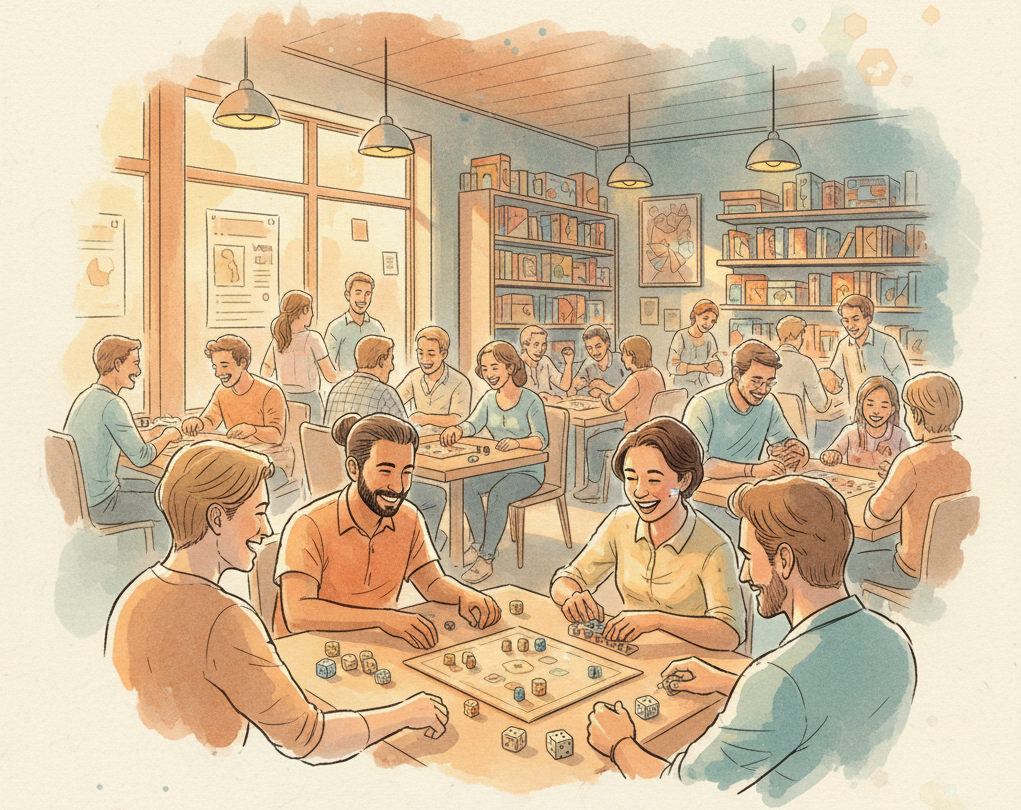
In cities from Calgary to Seoul to Cape Town, board game cafes are appearing in neighborhoods that wouldn’t have supported one a decade ago. The formula is consistent: pay a cover charge (or per-hour fee), browse a library of hundreds of games, and play for as long as you like while ordering food and drinks. Staff are usually available to teach rules for any game in the library.
The growth has been striking. What was a niche concept in the 2010s has become a mainstream entertainment category in the 2020s. And the demographic driving it is not the greybearded hobby gamer — it’s the same 20- to 35-year-old urban professional demographic that also drives the growth of online strategy platforms.
What does the board game cafe boom tell us about what players actually want? And what does it mean for online board gaming?
Why Cafes Work
Board game cafes solve several problems simultaneously:
The discovery problem. Walking into a game store and choosing a game to buy is overwhelming. Hundreds of boxes. Confusing cover art. No way to know if the game inside the box is actually fun for your group. Board game cafes let you try before you commit. The cover charge buys access to a library, and you can play any game there without purchasing it first.
The ownership problem. Owning a game requires space, money, and the willingness to take responsibility for having the right people at the right time. Cafes outsource all of this — the cafe owns the games, stores them, teaches them, and maintains them.
The social occasion problem. “Going out for a board game” is a socially legible activity in a way that “coming over to play games” might not be for casual acquaintances. The cafe provides a neutral, structured environment that works for dates, work outings, and friend groups who want a shared activity that isn’t passive.
The expertise gap. Learning a complex modern board game from a rulebook is a real barrier. Cafe staff who can teach a game in five minutes — demonstrating rather than lecturing — dramatically lower the barrier to entry.
What Cafe Players Want
The most popular games in board game cafes are not the most complex ones. They’re games that:
- Teach in under 10 minutes
- Play in 30 to 90 minutes (shorter for groups)
- Accommodate the range of player experience levels at the table
- Have a clear dramatic arc — tension, development, climax, resolution
- Feel different enough each time to warrant repeated plays
This is useful market signal. Cafe popularity correlates with accessibility and engagement more than with depth or complexity. The games that sell as physical products often differ from the games that perform best in cafes — there’s a distinct “cafe game” category that prioritizes the experience of the session over the experience of long-term mastery.
Strategy games with two-player competitive focus are a natural fit for the cafe environment: pairs can drop in, play two games in 90 minutes, and have a complete strategic experience that doesn’t require a full table of players or extended time investment.
The Cafe-to-Online Pipeline
One of the most interesting dynamics in contemporary gaming is the cafe-to-online pipeline: players discover a game in a cafe, enjoy it, and then look for ways to play it more regularly — often online.
This pipeline is particularly strong for strategy games. Casual players enjoy a single cafe session but don’t necessarily develop the motivation to purchase the physical game and organize regular play sessions. But the same player, having experienced the game, may be receptive to playing it online where the logistics problem is solved.
For online gaming platforms, this creates a clear opportunity: the population of players who have “tasted” strategy card and board games through cafe visits is large and growing. These players have cleared the discovery barrier — they know the genre is interesting to them — but they need an accessible, reliable online option to play regularly.
What Online Platforms Can Learn from Cafes
The cafe experience offers specific lessons for online game design:
Teach-ability matters. The best cafe games are ones that staff can explain quickly. The best online implementations are ones that teach themselves through tooltips, tutorials, and clear interface design. Friction in the learning phase produces abandonment. Smooth onboarding produces engagement.
Session completeness. Cafe sessions feel complete because games end within a natural time window. Online games should similarly respect players’ time — short enough to feel manageable, long enough to feel meaningful. The Blitz format in Gem Duel Blitz is a direct response to this design goal.
Repeatability. The games people want to play again in cafes are games that felt different the second time from the first. Randomness in setup, player adaptation, and the asymmetric nature of competitive play all contribute to this. Online implementations should ensure that variance is sufficient to make each game feel like a fresh puzzle.
Social ease. Cafes solve the social logistics problem. Online platforms solve the physical logistics problem. Neither fully solves the social dimension of gaming. The best online platforms are ones that acknowledge this limitation and build what community they can through matchmaking, leaderboards, and the sense of a shared player ecosystem.
The Broader Trend
The board game cafe boom and the online strategy gaming growth are expressions of the same underlying trend: a large and growing population of players who want games that engage their minds, fit reasonable time windows, and create the satisfaction of strategic accomplishment.
This population is not all the same — some want the physical ritual of a cafe visit, some want the accessibility of online play, some want both at different moments. But they’re driven by similar motivations, and they’re actively expanding the market for thoughtful competitive games.
That’s good news for anyone who makes or plays these games. The audience is there, it’s growing, and it’s ready for better options.